

The traditional date often feels more like a stiff interrogation than a romantic spark. We are all familiar with that exhaustion: sitting across from a stranger while the pressure mounts to perform a curated version of your life. It is essentially a corporate interview with better cocktails. By prioritizing vibe-vetting in relationships, modern daters are finally moving away from these staged performances in favor of something authentic.
By 2026, we are seeing a total rejection of the “isolated island” effect. This is the outdated concept where two people try to build a connection in a complete vacuum, stripped of their social circles and natural environments. It simply does not work anymore. Daters are now ghosting the candlelit pressure cooker and looking for compatibility where it actually lives: in the real world.
Vibe-Vetting in Relationships
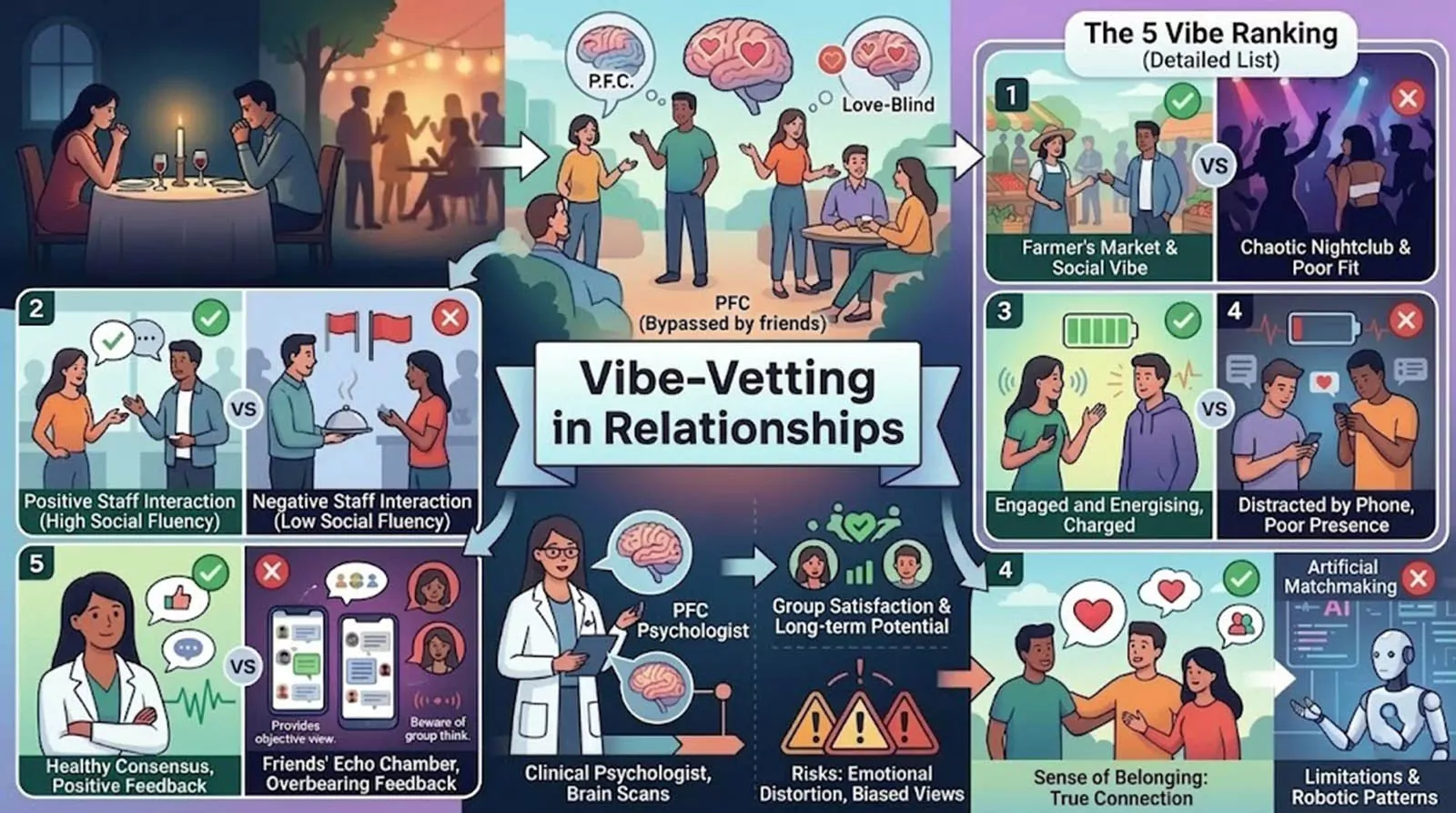
Enter vibe-vetting. This is not just a popular internet phrase. It is a genuine sociological shift. It is a survival strategy for modern romance. Vibe-vetting moves the evaluation process away from a private performance. It transitions dating into a collective reality. You stop asking how this person looks on paper. You start asking how they resonate with your actual daily life.
Compatibility is no longer measured in an empty room. We live in a fragmented and digital world. People are looking for more than just a romantic partner. They are looking for a missing piece of their tribe. Vibe-vetting in relationships is an intuitive assessment. It is an early stage evaluation of a potential partner. You look at their energy. You look at their true character. You look at their social compatibility.
This goes far beyond surface level traits. Nobody cares about an impressive job title if the person lacks empathy. We call this emotional vibe-coding. It represents a massive cultural shift. People are moving away from curated personas. They are moving away from trying to look effortlessly cool.
Instead, daters now prioritize vulnerability. They demand early and intentional communication. They want to avoid vague situationships at all costs. If a romantic interest cannot survive the chaotic energy of your inner circle, the relationship will probably fail. Your group chat is your ultimate filter. They see reality. You only see potential.
The Sociology of the Vibe
There is a hard science behind the collective gut feeling. Psychologists refer to this as thin-slicing. It is our human ability to find complex patterns based only on narrow windows of experience. Your close friends are absolute experts at this. They can read a room instantly.
When you first meet someone attractive, your brain floods with oxytocin. This chemical is wonderful for bonding. It is terrible for logical assessment. Oxytocin literally blinds you to obvious warning signs. We call this spark blindness. Your friends are not under the influence of this chemical cocktail. They remain entirely sober. They see the curated persona you miss and spot the cracks in their facade within fifteen minutes. This objective perspective from your social circle is precisely why vibe-vetting in relationships has become such a critical tool for modern emotional safety.
We are currently witnessing the absolute rise of Friendfluence. Modern dating data perfectly reflects this trend. Dating applications have pivoted their entire business models. Many major platforms now offer specific group date features. They do this to reduce ghosting. They do this to increase physical safety.
This technological shift highlights a deeper psychological truth. Everyone has a customer service voice for early dating. We are unfailingly polite. We are agreeable. We laugh at terrible jokes. We project an unnatural level of perfection. This creates a massive authenticity gap.
However, you cannot maintain that perfect mask in a noisy group setting. The cognitive load is simply too high. People mirror their true selves far more accurately when interacting with a crowd. A group dynamic forces genuine reactions. You see their actual patience levels. You see their unedited sense of humour. You discover the real gaps in their carefully constructed persona. A one on one dinner would never reveal these truths. Your friends act as a mirror for reality.
The Psychological Drive for Certainty
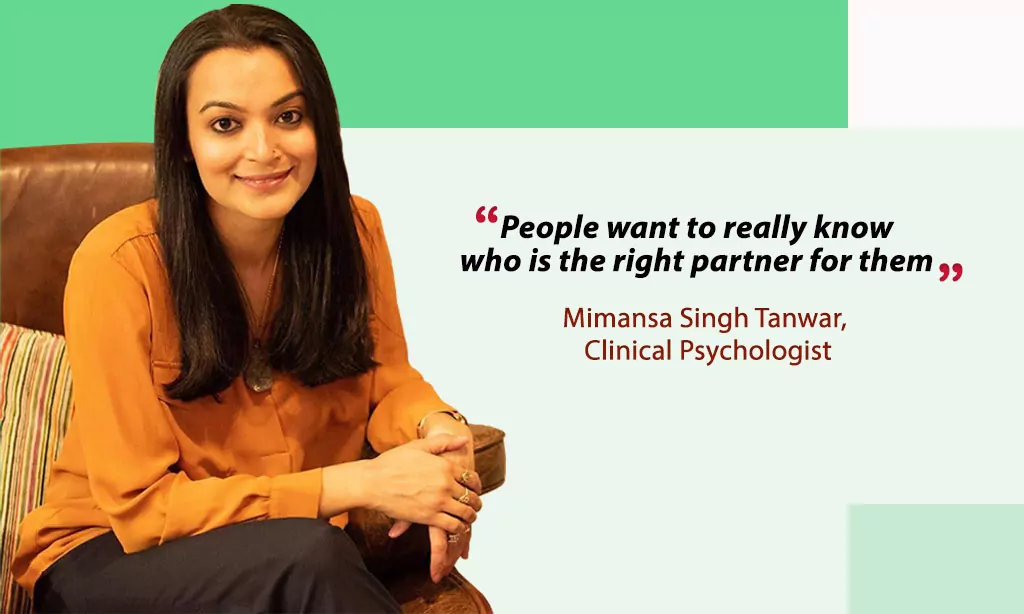
In an exclusive interview, Mimansa Singh Tanwar, Clinical Psychologist and Head of the Fortis School Mental Health Program, explained the psychology behind this shift to us.
“Vibe-vetting is driven by our human need to ascertain the uncertain and know the unknown. We use this approach to avoid relationship failures and gain control over our deepest fears. People want to really know who is the right partner for them. We constantly talk about the intentional effort required to build a relationship and overcome challenges. However, individuals want absolute certainty before making a commitment. They want to avoid emotional exhaustion and prevent losing that initial chemistry.”
The 5 Pillars of a Successful Vibe-Vet
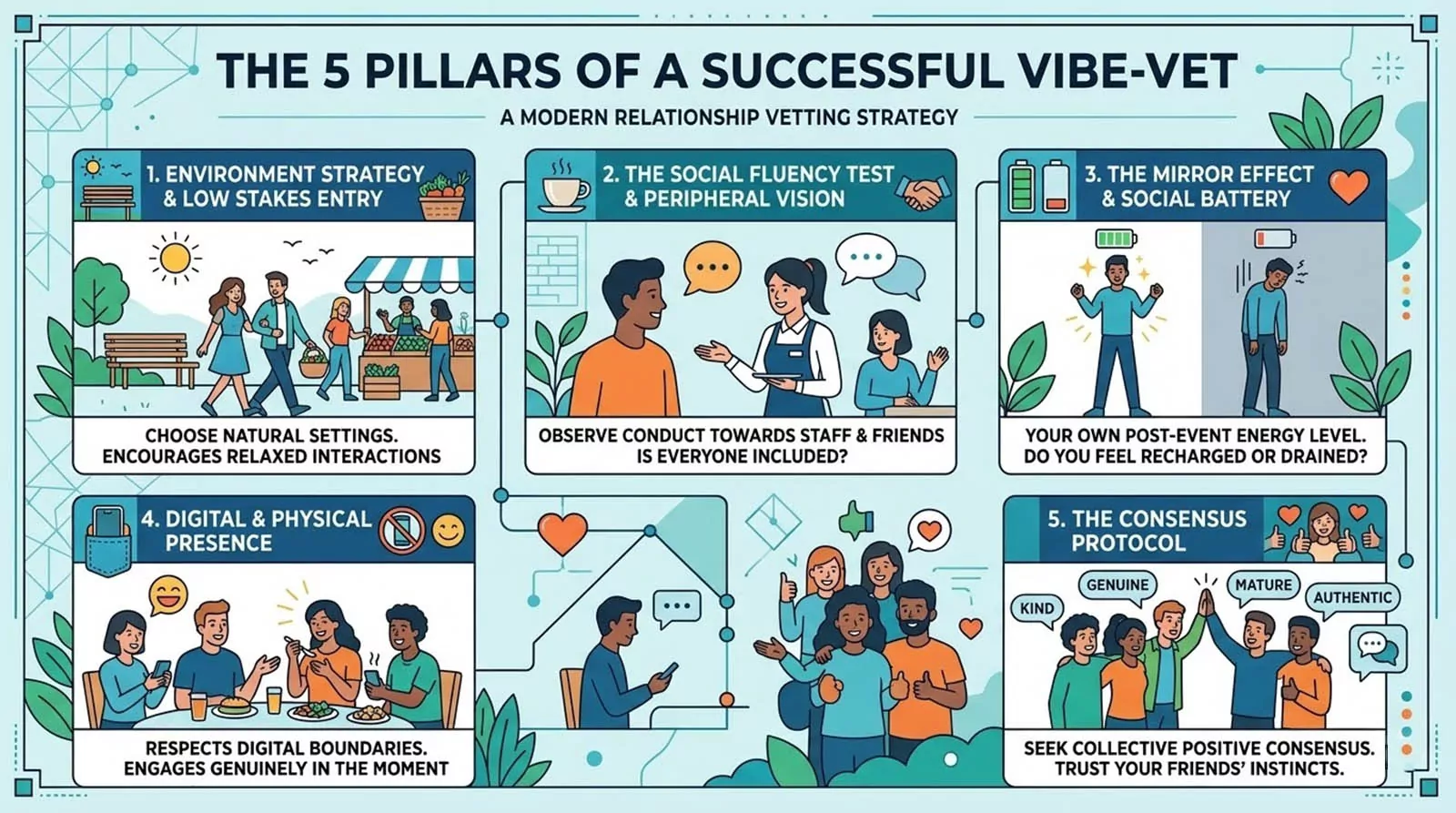
This is where the actual strategy begins. Not all group settings provide good data. You need a structured approach to rank the compatibility of a potential partner. These five pillars represent the ultimate modern vetting system.
Environment Strategy and The Low Stakes Entry: The physical location of the meeting is your foundation. A loud nightclub is a genuinely terrible place for a vibe-vet. You cannot hear anything. The sensory overload masks personality flaws. You need a low stakes environment. You want a Sunday farmers market. You want a casual outdoor activity. You want a daytime gathering where conversation flows naturally. Choosing these relaxed, accessible settings is the first step toward effective vibe-vetting in relationships.
- Vibe Score: 9 out of 10.
- Green Flag: They jump into the group activity without demanding to be the centre of attention. They ask your friends genuine questions.
- Red Flag: They look visibly bored. They refuse to participate. They complain about the venue you selected.
The Social Fluency Test and Peripheral Vision: You must evaluate their peripheral vision. This means watching how they treat people outside the direct conversation. Notice their interaction with the hospitality staff. Watch how they speak to the Uber driver. Most importantly, watch how they treat the quietest friend in your group chat.
- Vibe Score: 10 out of 10.
- Green Flag: They make eye contact with the server. They actively include the shyest person at the table in the conversation.
- Red Flag: They completely ignore support staff. They only direct their conversation towards you or the loudest person in the room. They lack basic social awareness.
The Mirror Effect and Social Battery: This pillar requires deep internal reflection. You must assess your own physical and emotional energy after the event. How does your social battery feel? Introducing a new partner to your friends is stressful. However, the right person will eventually make the space feel lighter.
- Vibe Score: 8 out of 10.
- Green Flag: You feel completely charged. You felt like the most relaxed version of yourself while they were present.
- Red Flag: You feel emotionally drained. You felt a constant need to apologise for their behaviour. You had to constantly explain their offensive jokes to your friends. They are energy vampires.
Digital and Physical Presence: Modern vetting requires observing digital boundaries. Emotional vibe coding heavily relies on physical presence. People reveal their character through their relationship with technology.
- Vibe Score: 7 out of 10.
- Green Flag: Their mobile phone stays completely hidden in their pocket. They respect unwritten no phone zones. They engage exclusively with the human beings directly in front of them.
- Red Flag: They constantly check their notifications. They perform exclusively for their Instagram story. They view your friends as background props for their social media content.
The Consensus Protocol: The post event debrief is sacred. You must solicit feedback from your group chat properly. They should not run your love life. Use a structured system. The Blind Ballot is highly effective. Ask every friend to text you one single descriptive word about the partner at exactly the same time. This prevents groupthink.
- Vibe Score: 9 out of 10.
- Green Flag: The group consensus is positive. Your friends feel the new partner naturally adds value to the existing dynamic.
- Red Flag: You receive a unanimous verdict that something feels dark or off. Your friends cannot specifically name the issue, but their collective gut is screaming.
Clinical Perspectives and the Science of the Herd
Relationship experts view this cultural shift positively. Evolutionary psychology confirms that third-party validation is a powerful survival mechanism. Early humans relied heavily on the tribe for mate selection. This behaviour is known to scientists as mate-choice copying. Our modern brains remain completely wired to trust the herd. We instinctively look for social proof before making major romantic decisions.
There is a hard neurological reason for this reliance on friends. During the early stages of romance, your brain actually works against you. Landmark fMRI research led by Professor Semir Zeki at University College London has demonstrated that the spark of romantic love actively deactivates the frontal cortex. This is the exact brain area responsible for critical social judgement and negative emotions.
Because this internal logical centre genuinely shuts down during the honeymoon phase, you become biologically incapable of seeing red flags. Your friends, however, remain completely sober. They act as your external prefrontal cortex, holding onto objective reasoning when your romantic mind abandons it.
Consider the modern group holiday instead of a traditional one-on-one date. Many couples now actively decide to bypass the usual three month masking phase. They invite a new partner into a high stress group situation early on. The stakes are instantly high. Unpredictable weather or lost directions happen naturally. The group chat sees everything unfold in real time. They see how the new partner handles extreme frustration. They witness a full year of genuine character development in forty-eight hours. The couple bypasses the fake polite stage entirely.
Collective chemistry is an incredibly strong predictor of long-term stability. Behavioural data consistently shows a massive correlation here. Partners who seamlessly fit into an established social circle report significantly higher relationship satisfaction. Good integration actively prevents toxic relationship enmeshment. Clinical psychologists define enmeshment as a dangerous state where boundaries dissolve. A couple completely isolates themselves and they lose their individual identities. Vibe-vetting in relationships directly prevents this isolation. It forces the romance to survive in the real world.
The Risks of the Echo Chamber
We must acknowledge the potential dangers. Vibe-vetting has distinct traps. Sometimes the group chat gets it completely wrong. You must remain vigilant against the echo chamber effect. Friends carry their own emotional baggage. They project their own insecurities onto your new partner.
You must learn to recognise friend jealousy. Is your best friend genuinely protective? Or are they simply terrified of losing their primary position in your life? Beware of friends with main character syndrome. These individuals may instinctively push back against any partner who does not pay them constant attention. You must evaluate the evaluators.
Maintaining personal autonomy is essential. Your friends are an advisory board. They are the jury. You remain the final judge. You must balance the external vote with your own internal compass.
Do not fall into the over vetting trap. This leads directly to dating by committee. Dating by committee destroys all organic romance. It turns love into a sterile board meeting. You must distinguish between a genuine character flaw and a simple personality clash. A friend might find your new partner slightly boring. However, that calm energy might be exactly the grounding force your nervous system requires. Accept the advice. Keep your agency.
Belonging as the New Chemistry
Vibe-vetting is not a cold or clinical exam. It is not an obstacle course designed to break people. It is a warm invitation into your reality. It is about ensuring a new person actually belongs in the life you have spent years building. You worked incredibly hard to curate your friendships. You built a safe and loving world. Why would you bring a disruptive force into that sanctuary?
We are moving towards a heavily automated future. Algorithmic matchmakers will become perfectly clinical. Dating applications will eventually use artificial intelligence to predict compatibility with terrifying accuracy. However, they will always miss the human element.
The messy reality of a group setting cannot be coded. The loud laughter over a spilled drink cannot be simulated. The unpredictable vibe of human connection will remain our final truth detector. We will always need the collective intuition of the people who know us best. Trust the process. Trust your own intuition. Trust the group chat.